crossRate=0.5
populationSize=20
stringLength=64
mutation rate=0.01
generationCount=5
Month: January 2005
Modal popup window
Are you nerdier?

Springwatch
‘Springwatch is the biggest ever survey into the arrival of spring across the UK. It’s run by the BBC in association with the Woodland Trust and the UK Phenology Network.’
‘We would like you to watch out for and record your first sightings of any of the six species below.’
and wouldn’t you know it I saw a seven-spoted ladybird on the 17th. Admittedly it was in my flat, but my window was open for a good hour before sighting (he protests wildly).
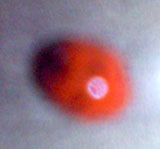
Ofcourse in true ‘ufo sighting’ stylee, I managed to only take a rather crap, out of focus photo. All I had to hand was my trusty camera phone.
Note this is nightime and I am trying to take a photo of a bug.
Still, there it was proudly displaying all seven spots. See it yourself in its full grainy, red blobiness:

and get this – ‘Spot them from February-March’, do-da-do-da-do-da-do-da (blog mood music). Global warming/FBI conspiracy/Ladybird hibernating in my flat over winter – who knows…..
grafedia
Technorati Whack – DataMining
Bournemouth
Lovely…

IxD
Lovely example of bad interaction design – I was walking past some flats yesterday and happened across the below.
Brought some wonderful images to mind of children parking cars and the emergency services having to pay and display round the corner to attend an incident.
It may obvious what the message is meant to be although is this more to do with the fact we are used to poorly laid out public messaging or simply that within the context our brains are able to think a little more laterally.
Note: I believe the design of the original UK road signs to be excellent. But as with many systems, increasing complexity does not necessarily increase understanding.


Genetic algorithms


Evolve
* Create an initial population of randomly-generated individuals
* Evaluate each member’s fitness (“fitness” depends entirely on the task in hand; a member’s fitness might be how many 1s its genes contain, or how well it plays chess using its genes as “weights” for various evaluation parameters)
* Kill the bottom x% (least fit) of the population (often 50%)
* Let the fittest members breed (“reproduction”):
Choose two members for breeding (“selection”) – lots of variations here: e.g. either select two at random (“uniform”), or weight the selection according to a member’s fitness (“fitness-proportionate”)
* Breed them (“crossover” – more options here: e.g., a child can be formed by single-point crossover (the parents’ genes are swapped over at some random point along their chromosome), two-point crossover (the parents’ genes are swapped over at two random points), uniform crossover (the parents’ genes are selected bit-by-bit randomly), and weighted crossover (the parents’ genes are selected bit-by-bit randomly but weighted according to each parents’ fitness)
* Apply mutation – each gene of the child is subject to a small chance of mutating to a different allele (an allele is a possible value for a gene, in binary, the alleles are “0” and “1”) – a common mutation rate is 0.001
* The children form the new population of members
* Go to step 2 until you’ve evolved a suitably fit member or population
Crossover rate = 0: no crossover
Crossover rate = 0.7: “normal” crossover
Crossover rate = 1: crossover always applies
Mutation = 0: no mutation
Mutation = 0.001: “normal” mutation
Mutation = 0.05: high mutation
String Length: 64
Population: 10
Crossover rate: 0.9
Number of Generations: 5
Mutation: 0.001