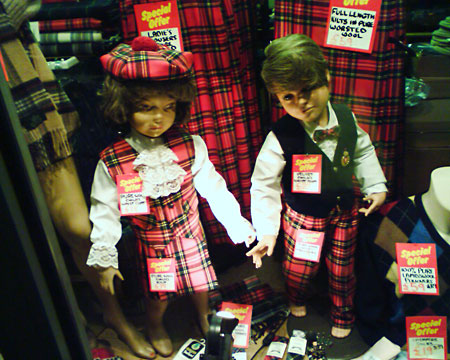
Stereotyping

One aspect of the classical view of stereotypes is the idea that social stereotypes exaggerate and homogenise traits held to be characteristic of particular categories and serve as blanket generalisations for all individuals assigned to such categories. The images and notions connected with them are then consensually shared in the interests of the social group among whom they are widely utilised and diffused. Such images and notions are usually held to be simplistic, rigid and erroneous, based on discriminatory values and damaging to people’s actual social and personal identities. In the classical view, stereotypes have been regarded as necessarily deficient. They distort the ways in which social groups or individuals are perceived, and they obscure the more complex and finite particularities and subjectivities tangled up in the everyday lives of groups and individuals. They are seen as deficient either because they encourage an indiscriminate lumping together of people under overarching group-signifiers, often of a derogatory character, or because they reduce specific groups and categories
to a limited set of conceptions which in themselves often contradict each other. Stereotypes are also discriminatory because the stunted features or attributes of others which characterise them are considered to form the basis for negative or hostile judgements, the rationale for exploitative, unjust treatment, or the justification for aggressive behaviour. In a word, stereotypes are bad. Politically, they stand in the way of more tolerant, even-handed and differentiated responses to people who belong to social or ethnic categories beyond those which are structurally dominant. Intellectually, they are poor devices for engaging in any form of social cartography, and for this reason should be eradicated from the map of good knowledge.

Excerpt from Stereotyping (Palgrave Macmillan)
Attack of the 6 foot Chickens

Finally got round to scanning some of my artwork I produced whilst on a Fine Art degree.

Ah…can’t quite remember the reasoning behind much of the work now. But it had something to do with the paradox of marketing (and thus beatifying) something inherently ugly (i.e. frozen chicken), I think it was supposed to be an ultra-realistic representation of the process of promotion whilst simultaneously attempting to deconstruct that process. Or maybe I just got a kick out of painting six foot frozen chickens in oil.

Chickens

Structuralism

The basic claim of the structuralist theorists was that a very wide range (perhaps all) of human activity, from economic interaction to literature, could be understood as being coded like language, bound by rules analogous to grammar and syntax….Its major weakness was its inability to provide any satisfactory theoretical account of historical or other development, which, however much part of the despised empirical universe, could not altogether be ignored. Consequently its intellectual standing was soon challenged by a much more theoretically powerful successor, Poststructuralism.

Excerpt from Postmodernism and History (Palgrave Macmillan)

The circular relationship between knowledge and reality

The cognitive system and its representational structure or knowledge cannot be understood properly if they are treated in isolation from the environment or as a static system. Rather they have to be seen as a part of a circular feedback process: the generated behavioural output influences – mediated by environmental structures – parts of the sensory input. The sensory input influences – mediated by the non-linear representation system – the motor output. Abstractly speaking, two feedback loops are involved, each interacting with the other and trying to achieve a state of equilibrium or homeostasis. From a biological perspective, the internal loop is responsible for keeping the cognitive system alive and coupled to the environmental dynamics in a stable manner via the external loop. Epistemologically speaking, this process can be interpreted as trying to achieve an epistemological equilibrium between the internal knowledge structures (embodying behavioural strategies) and external environmental constraints and perturbations (Maturana and Varela, 1980).

An excerpt from Organising Knowledge (Palgrave Macmillan)

Political Suicide for dummies

Step 1 – Try and stop plans to allow bars to open later.

I agree the plans are controversial but trying to stop them one week before the law comes into force could be a bit of a vote loser. Anyone under 30 and anyone owning a pub/bar/shop might be a little annoyed. Ofcourse all those living near a pub/bar/shop might be fairly happy.

Does..not..compute

Gah, Postmodernism overload….

A virtual island was bought over a year ago in the MMORPGs game Project Entropia for £13,700. Even stranger, the geezer has recently claimed that he’s made all his money back plus profit by:

selling land to build virtual homes as well as taxing other gamers to hunt or mine on the island

Aright, but it doesn’t exist! Its virtual, and run by a company that could turn off the servers any day. My worry for such ventures is probably in equal measure to my lack of understanding of this virtual world. However it does make me nervous, I mean lets face it there are a few things in this world that could do with developing, let alone the virtual. But although that’s a fairly valid point, the wheels of commerce care little for those issues if money can be made, virtual or real world.

I guess its a fairly natural progression for MMORPGs. They attempt to mimic the real world – so why shouldn’t every facet, including commerce and trade be part of it. But the trust network intrinsic in the game (which appears to be mostly about killing ones online opponents) must be immense for this to work.

Firstly the games people must be trusted with creating a fair and just world (which it probably must to ensure the gamers stay).

Secondly, that it does not constantly create islands and other such artefacts so saturating the market, thus unbalancing the online economy (although it does not profit directly from the acquisitions, a higher GDP of the game world the money and time invested is invested back into the world).

Thirdly, the users selling the artefacts to one another. Even with the use of mechanisms such as ebay (the online insurer/financial regulator?) there must be a huge risk in buying a virtual island.

Last month, another of Entropia’s virtual properties – a virtual space station – sold at auction for £57,000.

Where will this take us, poorly managed games ravaged by viruses are sent electronic aid packages from more successful online worlds. Worlds sick on power and success invading over online worlds. Virtual dictators, virtual capitalist giants, virtual philanthropists?

As our old friend Baudrillard once said

Virtuality, being itself virtual, does not really happen. One lives in the very Rousseauistic idea that there is in nature a good use for things that can and must be tried. I don’t think that it is possible to find a politics of virtuality, a code of ethics of virtuality because virtuality virtualizes politics as well: there will be no politics of virtuality, because politics has become virtual; there will be no code of ethics of virtuality, because the code of ethics has become virtual, that is, there are no more references to a value system

Indeed, but does he mean that there are no online politics in their own right as they have become virtual or that they simply mimic real politics? Whatever his exact point (which often escapes me with the big B) there probably is little point in arguing the toss over what should and shouldn’t happen in these worlds. Simply put – what will be will be.

Damn, it still bugs me though – 57000 Benjamins!

When Nerds attack – Google Print

I have been following the recent debate on Google print from both inside and outside the bubble. You see I work for a publisher, and although this naturally biases me towards one side, I feel I am rational enough to be able to look at the argument….well, rationally.

Some of the vitriol that is coming from both sides of the electronic fence is frankly harsh. In an almost teenager-ish paddy the nerds are claiming that Google is lovely and they just want to put all print works online for everyone’s benefit including the authors and publishers.

On Forbes, Nick Schulz responds with an op-ed of his own, “Don’t Fear Google,” in which he masterfully deconstructs Schoeder and Barr’s crazy-talk

Crazy-talk? I though this was meant to be a debate? Yes Google, so far, are lovely and they genuinely want to do good. However they are also now a public company and those shareholders have to be kept happy. What if Google one day decides to do something a little more with that material.

Indeed it ain’t all fluffy bunnies on the other side:

And so we find ourselves joining together to fight a $90 billion company bent on unilaterally changing copyright law to their benefit and in turn denying publishers and authors the rights granted to them by the U.S. Constitution. – Source

Indeed offering snippets isn’t really changing copyright at all.

It seems to me, that like in many arguments, the real issues aren’t being addressed. Instead nasty insults and insinuations are thrown about trying to make the other side cry.

I think the main problem has been that Google just announced they were going to start up this project with the disclaimer that if you tell us exactly which books you don’t want published then we won’t do it. The publishers and authors were probably more miffed that they weren’t consulted on Google’s new venture. Now ofcourse the Nerds are saying that the publishers and authors are just looking to make money out of this whereas lovely Google simply wants to teach the world how to sing.

I see the arguments on both sides and genuinely feel that if Google works with the publishers and listens to the authors then everyone will probably be happy. Google will provide more eyeballs for titles, thus increasing sales for Publishers and thus author royalties and Google will make a stack of cash from the ads placed next to them.

All of this rather nasty speak is really just clouding the issue.

Dear god

Dear god it’s true.

My brain is having difficulty dealing with the ironies. Has a solar flare gone off or something?

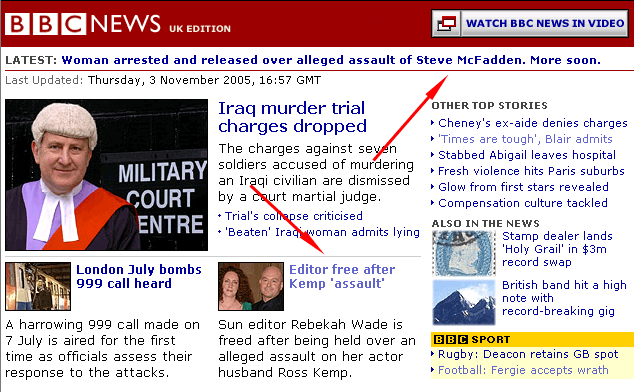
Beeb

Are the Beeb having a laugh?

Eastenders

Seems as though Grant and Phil have been beaten up on the same day by different women. Brilliant coudn’t make it up – well unless the BBC have ofcourse?

2026 2025 2024 2023 2022 2021 2020 2019 2017 2016 2014 2013 2012 2011 2010 2009 2008 2007 2006 2005 2004